
How to Get Into AI Answers: A 2026 Playbook
A friend messaged me in January — he runs a custom furniture website: "The site works, SEO is fine, we've hit page one of Google for our city. But AI doesn't know the company exists. How do I get into ChatGPT? How do I get into AI answers at all?"
We asked AI engines about his niche — they listed competitors. Google's AI Overview did the same. Perplexity gave a third list, and his company wasn't on any of them. The site is 8 years old, the business has run since 2013, and a couple of those competitors are objectively weaker.
The thing is, the competitors didn't beat him on budget, links or domain age. They beat him by making the site legible to AI — in the code markup and in the brand's footprint across the web. Why this happens to a real business: why AI recommends your competitors. If you specifically need ChatGPT, see our dedicated guide to ChatGPT answers; this one is about AI answers in general.
Why Your Site Doesn't Appear in AI Answers Even at the Top
The site was good for people: nice design, sensible copy. But AI looks at a page differently. It doesn't read — it pulls out fragments. If the specifics are buried in the middle of a paragraph among generic phrases, the AI simply won't see them. That's why a site stays out of AI answers even when classic SEO works.
Three things stood out right away:
| What was on the site | Why AI walks past it |
|---|---|
| Product specs as solid prose | Competitors use tables and lists. AI takes ready data from those, not from paragraphs |
| No names anywhere: posts without authors, an About page with no dates or details | ChatGPT and voice assistants look for trustworthy sources. Anonymous text isn't one |
| Almost nothing off-site: empty map listing, zero mentions | AI scans maps, directories, media and forums. If it's silent there, there's nothing to cite |
Before changing anything, it helps to understand why AI visibility matters and what AI currently reads on your site. You can check it in 30 seconds — free, no sign-up.
How to Get Into AI: A Step-by-Step Plan
No magic. Five actions over a month. But order matters — don't skip steps. What you can do without code, and what to hand off: promoting your site in AI search: what to do yourself vs hand off.
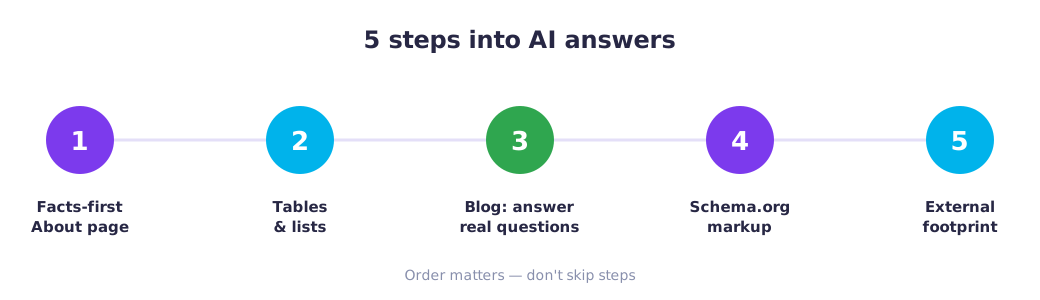
Step 1. A facts-first About page
Drop "we're a team of professionals with years of experience." Replace it with the founding year, the number of completed projects, company details and the names of key people. If the owner gave an interview or spoke at a conference — link to it.
AI doesn't judge nice wording — it looks for specifics it can quote. "In business since 2013, 400+ projects delivered, founder John Smith" is quotable. "We're the best at what we do" isn't. It's one of the most underrated ways to get into AI answers: just give the AI facts instead of fluff.
Step 2. Tables and lists wherever they fit
My friend's competitor did a simple thing: instead of a paragraph per kitchen model, he put the specs in a table. Material, lead time, dimensions, door type — a few rows, and the AI sees everything instantly. This works for any business: services as a table of prices and timelines, products as spec rows, comparisons as columns.
| Model | Material | Lead time | From |
|---|---|---|---|
| Classic | Solid oak | 30 days | $2,400 |
| Loft | MDF + metal | 21 days | $1,300 |
| Minimal | Laminate | 14 days | $800 |
An AI will quote a table like this almost verbatim — unlike a paragraph with the same data.
Step 3. A blog that answers real questions
The classic mistake: a blog of three posts about "the benefits of natural wood" and "kitchen design trends." Pretty, and useless to AI.
People don't search for "the benefits of natural wood" — they search "how much does a solid-wood kitchen cost," "which door material is best," "how to care for a wooden countertop." Write for those queries: each post leads with a direct answer in the first two sentences, no preamble. An author name and date are mandatory. A byline like "John Carter, furniture production engineer, 11 years' experience" is worth more than another author-less post: it tells the AI an expert is speaking.
Step 4. Schema.org markup
Briefly: it's a way to tell the AI in code — "here's who we are, here's the author, here's the question and its answer." Organization on the homepage, Article on blog posts, FAQPage on Q&A pages.
It validates in a minute and ships in an evening with a developer, and the payoff is one of the fastest. If the term scares you, we have a plain-language guide to schema.org.
Step 5. An external footprint
AI doesn't end at your site. It goes to maps, directories, local portals and industry round-ups. If there's nothing about you there, you're invisible — however good the site is.
What worked for my friend: one day filling out a business listing — workshop photos, description, hours. He asked customers to leave reviews. He gave an interview to a local outlet. Three off-site mentions, and the AI saw the brand and started counting it. That minimum is enough to kick off the process.
What Happens When AI Knows Your Site
Five months later (it takes time) ChatGPT named the company in its answers. Other AI engines too. With the ad budget unchanged:
| Metric | Change over 5 months |
|---|---|
| Blog traffic | +40% |
| Site leads | +20% |
| Ad budget | unchanged |
But the numbers aren't the point. The point is the owner stopped being invisible to the audience that searches through AI answers instead of a search box. And that audience grows every month.
Why It Pays to Prepare Your Site for AI Now
A couple of years ago this was a hobby for geeks. Today it's the norm: per Bain & Company, about 80% of users rely on AI-written answers at least 40% of the time, and nearly 60% of searches now end without a click to any site. Pew Research Center adds that when an AI summary appears, people click a link about half as often.
People ask "where to buy," "what to choose," "who's trusted." If you're not in the answer, the customer goes to whoever the AI named. And competition in AI answers is still lower than in classic search — many simply don't know how to get in. Those who figure it out now will set the rules a year from now.
Frequently asked questions
How do I get into AI answers?
Make your site legible to AI: a facts-first About page with real details, specs in tables and lists, a blog that answers customers' actual questions, Schema.org markup (Organization, Article, FAQPage), and external mentions — maps, directories, industry media. Order matters: start with facts and structure, finish with the external footprint.
How do I get into ChatGPT answers?
ChatGPT cites sources it trusts and can pull a ready answer from. You need a named author with expertise, publication dates, structured data (tables, FAQ), Schema.org markup and brand mentions off-site. Anonymous promotional copy almost never makes the answer.
My site ranks #1 but isn't in AI answers — why?
Classic SEO and getting into AI answers are different jobs. A search engine ranks the page; AI pulls a specific fact out of it. If the specifics are buried, there's no author and no external mentions, AI walks past even a #1 result.
How long does it take to get into AI?
First mentions usually show up 2–4 weeks after changes, a stable presence in 2–3 months. In the real case in this article, ChatGPT and other engines started naming the company after about five months.
Do I need a developer to get into AI answers?
Most of it you can do yourself: rewrite the About page, add tables and a blog, fill out directory listings. A developer is mainly needed to install Schema.org markup correctly — an evening's work.
How do I check whether AI can see my site?
Run a free GEO / AEO audit: it shows whether your site has Schema.org, E-E-A-T signals and the structure AI needs to cite you. Results in 30 seconds, no sign-up.
How do I appear in AI search results?
The principle is the same for any AI: give it facts that are easy to quote. Specifics on the About page, specs in tables, a blog with direct answers to customer questions, Schema.org markup and brand mentions on external platforms. The easier it is for AI to extract a ready answer from your page, the higher your chances of appearing in its results.
What can I do so AI recommends my company to customers?
AI recommends those it understands and trusts. Your site needs concrete facts (prices, timelines, services, company details), a named real author and company, and online — reviews, directory listings and mentions. Then, when a customer asks "who would you recommend," AI has something to say about you.
Is it even worth it for a small business to bother with AI?
Yes, and doing it now pays off more than later: competition in AI answers is still lower than in regular search, while the share of customers who ask ChatGPT or a voice assistant for advice instead of a search engine grows every month. The basics — facts on the site, tables, filled-out directory listings — a small business can do itself in a couple of evenings.
Check Your Site Right Now
Free audit for AI and voice search visibility (GEO / AEO) — no sign-up, takes 30 seconds.