
Why AI Recommends Your Competitors Instead of You — and How to Fix It
"I asked the AI — it named a competitor"
The owner of a small dental clinic was testing AI search: "Recommend a good dentist near me." The assistant returned three clinics — his wasn't among them.
He double-checked in ChatGPT. Then Gemini. Then Perplexity. The same competitors everywhere — people he knows personally. One clinic opened three years ago, another has a four-page website. His practice is in its ninth year, the site is six years old, and in classic search they sit firmly in the top five.
It's not random — AI really does choose
People increasingly don't scroll through links — they ask and get a ready-made list. Per Bain & Company (2025), about 80% of users rely on AI-written answers at least 40% of the time, and nearly 60% of searches end without a click to any site. So if AI recommends competitors instead of you, you lose customers before they even open a browser.
It's not a conspiracy. AI doesn't "search" the old way — it doesn't compare rankings or count links. It extracts ready facts: the sites it understands get recommended, the ones it doesn't get skipped. Why AI recommends competitors comes down to three simple reasons. In short, it all comes down to whether AI sees your website.
How AI Decides Whom to Recommend
No jargon. Picture how AI "reads" a site — it's nothing like how we read. (Want the deeper, technical version? See the separate breakdown of how AI engines choose which sources to cite.)
AI looks for ready answers, not generic phrases
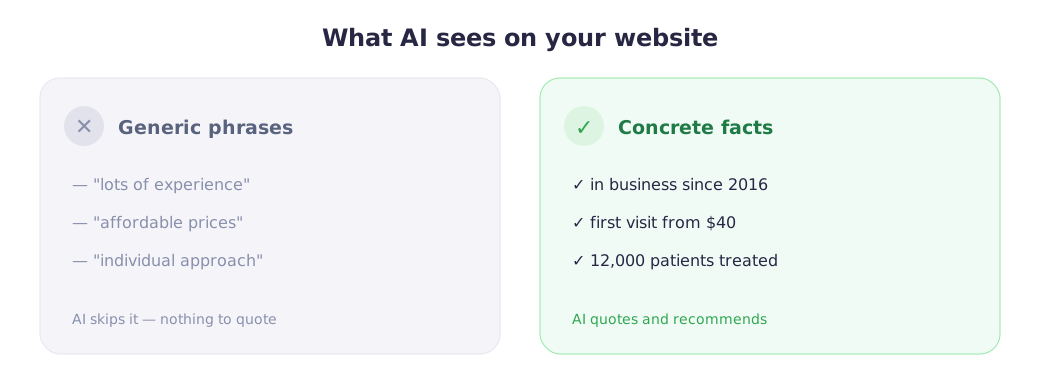
A human reads "an individual approach to every client" and assumes the company tries hard. AI skips that paragraph — there's nothing to take: no number, date or fact. But "in business since 2016, 12,000+ patients treated, first visit $40, payment plans available" it sees instantly — and on "recommend an affordable dentist" it grabs the price and the track record. That's why AI recommends competitors: they have something to quote, and you don't yet.
AI trusts those it "knows"
AI doesn't stop at your own site — it checks whether the business exists elsewhere: maps, local directories, industry portals, forums, news. If a company is mentioned across several independent sources, AI treats it as real. If the only place it exists is its own website, to AI it's anonymous. That's why ChatGPT doesn't know your business — it has nowhere to learn about you.
AI needs structure, not a wall of text
For AI, text comes in two kinds: text you can pull a fact from — and text you can't. Tables of specs, bulleted lists, question-and-answer blocks are the first kind; facts are extracted instantly. A wall of text, however well written, is the second: AI won't wade through three paragraphs — it takes the answer from whoever put it in a table.
Five Reasons AI Doesn't Show Your Site
Each shows up on real sites again and again. Start with the biggest: no specifics on the site. Compare two descriptions of the same service:
| Generic phrases — AI skips them | Concrete facts — AI quotes them |
|---|---|
| "Experienced doctors, affordable prices, individual approach" | "Treating since 2016, 4 therapists and 2 surgeons, first visit $40, payment plans" |
| "Years of experience" | "12,000+ patients treated" |
| "Modern equipment" | "Digital CT scanner, treatment under a microscope" |
The competitors AI recommends almost always use the right-hand version. The full list of reasons:
| Reason | What to do |
|---|---|
| No info about you beyond your own site | Create and fill out a Google Business Profile and local directories; add 2–3 mentions on local portals |
| No concrete facts on the site | Replace generic phrases with numbers, dates and prices; put specs into tables and lists |
| The site is technically closed to AI | Check robots.txt (GPTBot, Google-Extended), a valid SSL certificate, load speed |
| AI doesn't understand who you are | An About page with the founding year, names, company details and numbers |
| Competitors already did it | Catch up: a price table, an FAQ block, directory listings, articles signed by a real expert |
The unfairness: a competitor isn't necessarily better at the product — they simply made their site clearer to AI. The good news: the gap is closed in weeks, not years.
What to Check Right Now
Nothing to download or sign up for. Five minutes of self-checks.
Ask ChatGPT and other AI about your niche
Type three phrases: "Recommend a [service] in [city]", "Where to buy [product]", "Which companies do [activity]". Note who gets named. If you're not there, you've just seen with your own eyes that AI recommends competitors — and your customers see the same.
Check whether AI can see your site
Paste your site address into a checker — in 30 seconds it shows what AI knows about you, which pages it can reach and what blocks you from recommendations. No coding needed: you can run a free GEO / AEO audit by URL.
Compare your site with the competitor's
Open the competitor's site and yours in two tabs. What do they have that you don't — a price table? An About page with numbers? A Q&A block? Find three differences — that's your first task list.
How to Get AI to Recommend You
The simplest steps — a developer is needed almost nowhere. What you can do by hand, and what to hand off: promoting your site in AI search: what to do yourself vs hand off. If you want the full plan, we have a detailed step-by-step guide to getting into AI answers. For ChatGPT specifically, see how to get into ChatGPT answers.
Add facts to the site
Replace generic phrases with concrete ones: "lots of experience" → "in business since 2016", "many clients" → "12,000 patients treated", "affordable prices" → "first visit $40". Put specs into tables and lists. This is the first thing that changes the situation when AI recommends competitors instead of you.
Tell your story — like a human
One evening on the About page: who you are, when you started, what you've done, why you can be trusted. Company details are a must; a photo of the owner or team helps. For AI this is the key signal: "I'm a real business, here's the proof."
Fill out directory and map listings
A Google Business Profile and local directories — free, an hour of work. Add a description, photos, hours; ask customers for reviews. AI will start finding you beyond your own site — exactly what it lacked when ChatGPT didn't know your business.
Add a question-and-answer block
The most powerful move. List 5–10 common customer questions phrased the way people search: "How much does...", "How does... work", "What's included in...". Under each, a short 40–60-word answer. AI pulls ready question → answer pairs directly — one of the fastest ways to get AI to recommend you, and it works without a developer.
Check technical access
A free audit shows what blocks AI from reaching the site: robots.txt, SSL, load speed. If there are problems, it's a couple of hours for a developer — not weeks.
How Long to Wait and What Counts as a Result
Honestly: not tomorrow. AI engines don't refresh sources instantly. First mentions usually appear 2–4 weeks after the fixes, a stable presence in recommendations in 2–3 months.
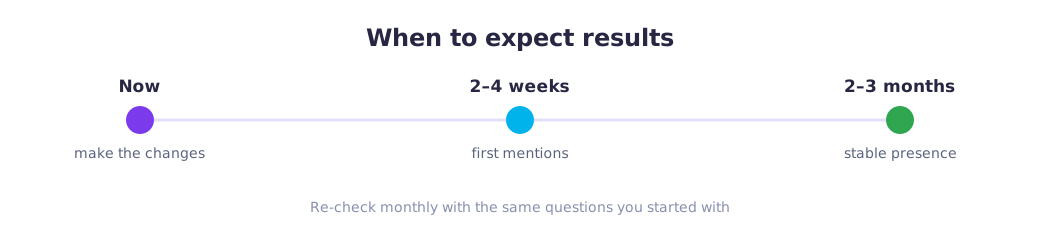
Checking is simple: once a month, ask AI the same questions you started with and see whether you show up. It's not a race for first place — it's about presence: does AI recommend you yet or not.
Frequently asked questions
Do AI search engines affect business sales?
Yes. Per Bain & Company, about 80% of users rely on AI answers at least 40% of the time, and more and more decisions — choosing a dentist, ordering a kitchen, buying parts — start with an AI question. If AI doesn't show your site, the customer goes to whoever it named.
Do I need a developer to get into AI recommendations?
Most of it you can do yourself: facts on the site, directory listings, an FAQ block, the About page. A developer is needed for one thing — checking robots.txt and adding technical markup. A couple of hours of work.
How expensive is it to get a business into AI recommendations?
You probably already have a site, directory listings are free, and the audit is free. The real cost is time and maybe a few hours of a developer. None of the steps requires an ad budget.
How do I get into AI answers if I don't know SEO?
There are tools that check a site automatically: paste a URL, get a list of what to fix, hand it to a developer. You don't need to understand search engines — knowing that AI recommends competitors is enough; the tool shows exactly what's blocking you.
Does a small business need AI search visibility?
Small businesses need it most. Big companies have long approvals and slow vendors, while you have a 6–12 month window to claim spots in AI recommendations before the giants' budgets arrive. By the time they wake up, you're already on the list.
Want to add AI markup (GEO, AEO) to your site?
We can help. Get in touch — we'll walk you through the terms of implementing the code for your site.
Email: info@seofetcher.com