
Promoting your site in AI search: what to do yourself, and what to hand off
We’ll take a law-practice site with steady mid-range positions in search. Once they decided to promote the firm in ChatGPT and similar AI answers, the fork was: do it themselves or hire an agency. An agency typically starts with a technical site audit — a few hundred dollars — then builds a strategy from that audit. That order is right.
There is no developer or AI-search person on staff, so a full-service package looks logical. Paying thousands a month right away still stings: the site is live, clients already come from search. It usually feels like two options — a turnkey agency, or stalling. There is a third path: it takes time and attention from you.
Doing AI search work yourself does not cancel an agency and does not promise everything in a day. It is a way not to mix copy, a site check, and code in your head.
Copy, code, and a retainer are different jobs
This article is about choosing a path: what you do yourself, what you hand to code once, and what belongs on an agency retainer — and how not to buy one instead of the other. Why a site should show up in AI answers at all is on whether AI can see your site.
Turnkey AI promotion: an overview of the service, and how not to overpay
We do not sell a turnkey retainer — we do a site check and one-off markup. Here is a breakdown: how agencies usually run that service, and where a few days of setup gets sold as a full package.
At a professional agency, full AI-search promotion is an ongoing process, not a one-off code setup. You pay for systematic work that is hard to do yourself: strategy, copy, brand authority, and a check on whether AI names you.
What a real turnkey package includes
- Strategy — which pages and which client questions come first.
- Copy — facts a model can quote, not slogans.
- Brand mentions — industry sites, directories and articles, not one map card.
- Reporting — a regular read on whether ChatGPT and other answers name you.
How not to buy a one-off job dressed as a retainer
Some agencies, though, sell simple one-off tasks as monthly full-service work. If the contract lists only a basic maps profile, an on-page Q&A block or one technical script, that is not a retainer. That kind of work is done in a few days with a developer. When you pick a vendor, judge the detailed scope — not the word “turnkey” on the quote.
Who a monthly retainer fits
- you will pay to hand the project off and save your own time;
- competition is high, or you have multiple locations;
- SEO is already on a retainer, and AI is added to the same contract.
Personally, I am sure a full turnkey programme like this — brand authority, not one script — would help any site, even one that is already fairly strong. Over time the effect is real. Being honest: the service is expensive. No budget for a retainer is not a reason to stop. The trap is buying basic setup dressed as a costly “package.”
You can finish some of the copy yourself and order a one-off technical setup from a developer. After that the site is ready to work with AI search. It will not be global promotion at the start, but it is a solid foundation: over time the models will start to notice the site — because they can read it — and show it in answers.
AI promotion checklist: real retainer vs a lookalike
To avoid overpaying, keep this list next to the quote.
| What real turnkey promotion includes | What they try to sell as a “full package” |
|---|---|
| Ongoing strategy: competitors, live client questions, and a plan that gets updated | A one-off: check whether markup exists, once for the whole period |
| Regular copy: new and updated pages for new questions people actually ask | One-time edits: rewrite About or the price list — work you can do yourself |
| Reputation (PR): regular pieces on industry sites and links from real sources | Minimum effort: one filled directory card sold as “major PR” |
| Technical support: bot access, code and markup updates when the site changes | A template: one “AI” script with no copy and no mentions |
| Clear reporting: monthly notes on whether AI names you, and what to do next | Empty promises: “you will be in ChatGPT by Friday,” with no method |
What to do yourself vs hand off: three layers of AI search work
Copy and facts are required: that is knowledge of the business. A site check is worth running first: not a retainer and not a package, a list so you do not do the code blind. Code is optional: your developer, or a one-off from us.
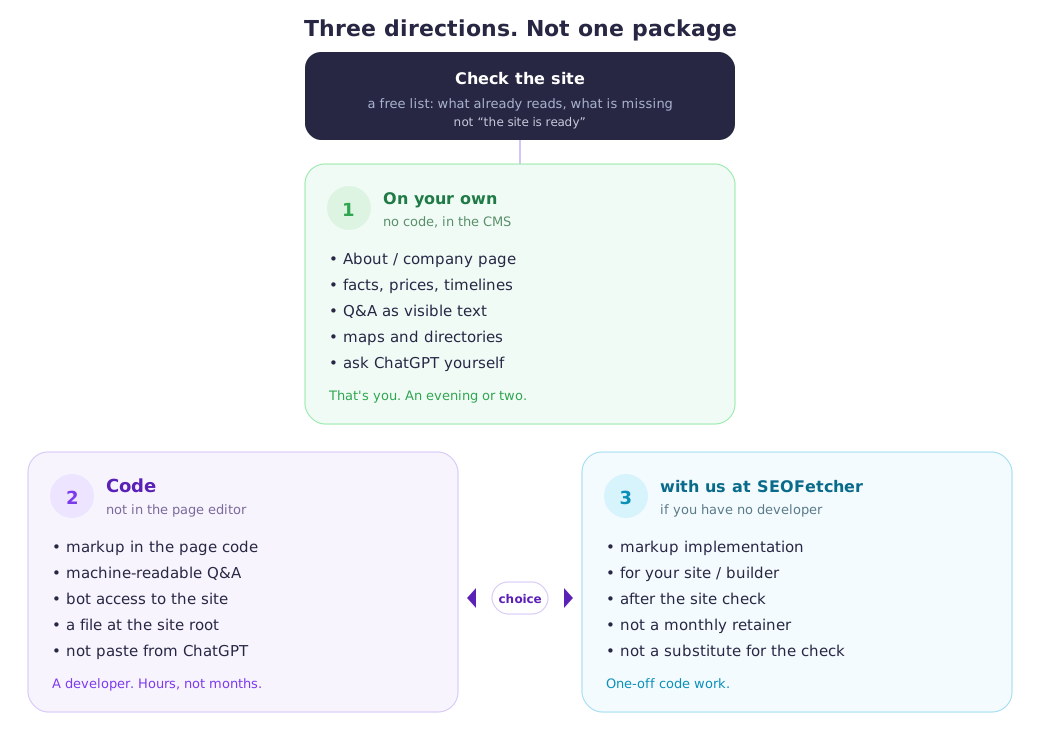
| Layer | Who does it | What’s in it |
|---|---|---|
| Copy and facts — required | You, in the CMS | About page, prices, on-page Q&A. Map and directory listings |
| Site check — do this first | You, from the report | A free list: what already reads, what is missing |
| Code — optional | Your developer, or a one-off from us | Markup, bot access, root files. A one-off fee, not a subscription |
Copy stays yours: neither an agency nor a tool has that knowledge. Code, if you take it, does not have to be a year of management — often a one-off setup.
How to check the site before you spend on AI promotion
Do not guess from one ChatGPT conversation. Today’s answer, tomorrow’s different one: the model may have used a directory, remembered an ad, or mixed up two companies with similar names.
Start by getting a list of the site’s technical readiness. The free AI visibility audit shows what already parses, what is missing, and where a bot dies on a block. No sign-up. It is not a promise that you are in the answers now — it is a list you can actually work from.
If you need a walkthrough, read the AI-readiness checklist. The check is faster. The checklist is useful when you want to tick the boxes yourself.
Free site check first, then pick a path
The check does not rewrite your About page and does not replace an agency. It is a list you can work from yourself — or keep next to the contract if you buy turnkey management.
What to do with the report: DIY or cross-check the agency
Once the SEOFetcher check report is open, you do not have to email “take us for a year” — and you do not have to fix everything yourself. Sort the rows: what you fill in the CMS, what goes into code once, and what, if you are on a retainer, you simply check against what the agency promises each month.
| In the report | If you go DIY | If a turnkey agency |
|---|---|---|
| No facts, empty About, no on-page Q&A | You fill this in the CMS | Check: is it on the site, or only in the pitch deck |
| No markup in the code, bots cannot enter | A developer or one-off markup implementation | Usually in the technical block of the retainer — ask for a date |
| No map file for AI tools | Often not urgent | Not the main clause of the contract |
| “Everything is red” | Copy first, then code. Not a retainer by default | The report is the brief and a monthly check, not a reason to pay for nothing |
Your developer closes the technical rows from the report as a brief: who you are as an organisation, Q&A markup where the questions already exist as text, bot access for ChatGPT and search. No developer — that layer can be a one-off markup implementation, without a monthly “we will promote you.” That is not a cheaper agency. It is the code slice when you do not need a retainer.
A month-long plan without the DIY / agency fork is in how to get into AI answers. ChatGPT-specific steps: how to get into ChatGPT answers. Here they stay unmixed: retainer versus one-off work. If the report flags a root file, see llms.txt for a site.
What you can do yourself for ChatGPT — no developer
No FTP, no “paste this script into the head.” Everything here lives in the CMS. AI cites facts, not slogans. Why competitors get named more often: why AI recommends your competitors. Below is the job boundary, not the full plan — the step-by-step is in how to get into AI answers.
- About page — name, start year, legal details, facts instead of “a team of professionals.”
- Prices and timelines — in lists and tables, not a wall of prose.
- On-page Q&A as visible text — 5–10 real client questions. That is not markup in the code yet: “I wrote a FAQ” ≠ “I added the schema.”
- Maps and directories — description, photos, hours, real reviews. AI looks off your site too.
- Asking ChatGPT yourself — a smell test, not a substitute for the report.
This is the owner’s layer. Without it, markup in the code often has nothing to sit on — and an agency cannot invent your business facts for you.
What code the site needs so ChatGPT understands it
This is everything that does not live in the visual editor. You change copy yourself. A script in the page, a root file, rules for bots — you usually cannot. Often hours, not months — but it is no longer “I edited a paragraph in the CMS.”
| Task | Why NOT on your own | Where it goes |
|---|---|---|
| Markup in the page code | A script, not a text block | Developer or implementation |
| Q&A for machines | Visible text ≠ markup in the code | After the questions are already on the page |
| Bot access to the site | A root file. A bad block and the bot never enters | A developer, if they know where to look |
| A map file for AI tools | Also a root file, not a menu page | Not first priority for every site |
Do not copy a chunk of code from ChatGPT and paste it into the builder on a guess. A broken script is worse than none. Markup belongs in the theme, a plugin, or an HTML embed. The root file without the magic: llms.txt for a site. For most service sites, a clear organisation and questions people can already read come first.
Frequently asked questions
Can I get into ChatGPT without an agency?
Yes. The DIY path: copy and listings yourself, a free site check, code once — a developer or markup implementation. A turnkey agency is a different volume: monthly management. Both are real; they should not be mixed.
What can I do for ChatGPT with no developer?
Rewrite About with facts, put prices and timelines in lists, write 5–10 Q&As as visible text, fill in map listings. That is not a substitute for markup in the code, but markup often has nothing to sit on without it. Full step order: how to get into AI answers.
Why pay for markup if the site check is free?
The check is a list, not work in the code. Pay for implementation only if you go DIY and nobody can put the markup in. If you buy a turnkey retainer, tech is usually already inside it — then a separate paid markup job on top of the fee is often unnecessary.
Do I need a developer to show up in ChatGPT?
For copy — no. For markup in the code and the bot-access file — yes, or one-off help. Do not paste code from a chat into a builder: a broken script is worse than none.
Where do I start if ChatGPT doesn’t know the company?
The free site check. The report shows whether you go DIY or cross-check an agency retainer. Why this matters for a business is whether AI can see your site — that page is not the checker.
What does turnkey AI search promotion usually include?
At a good agency it is bigger than code: which questions to push, copy, mentions on authoritative sites, markup, and a check on whether you are named yet. Markup is a slice of the package, not the package. If the “full service” is only what you would finish yourself or with a developer in one pass, it is not turnkey — it is one-off work under another name. Read the scope, not the label.
Do you sell monthly AI search promotion?
No. SEOFetcher gives a free site check, and then, if you go DIY without a developer, we can implement the technical markup in the code as a one-off. A retainer to “promote you in ChatGPT every month” is an agency service, not our product.
Which sites can you add markup to?
Builders and custom sites: WordPress, Webflow, and a custom stack. The method differs — theme, plugin, or template — the point is the same: code on the pages so ChatGPT can read the site.
Going DIY and the report is red only on code?
If you do not need an agency retainer and have no developer, markup can be put on the site once. That is not a subscription and not turnkey promotion.
Email: info@seofetcher.com